Built inside a working animation studio. Free during the public production test.
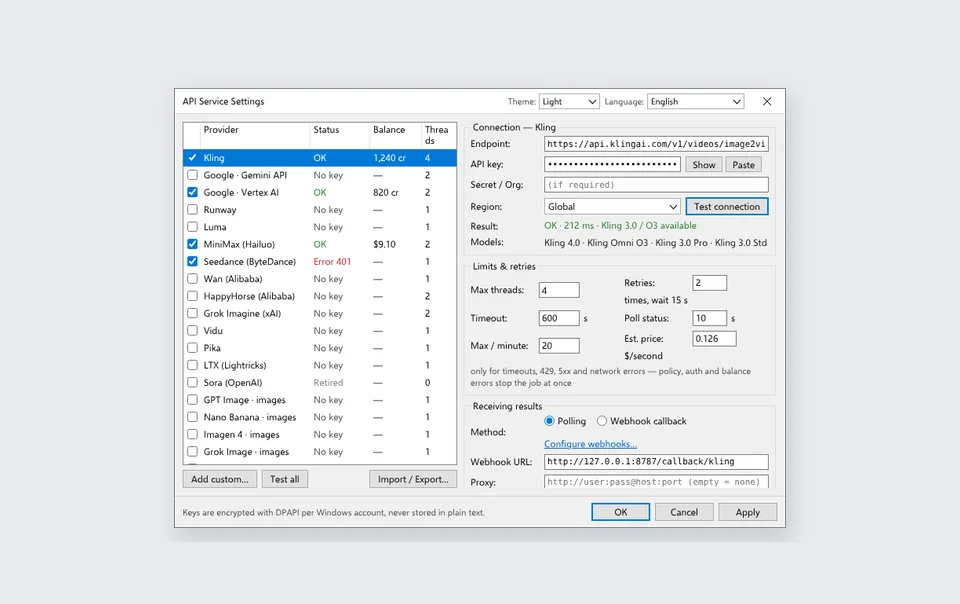
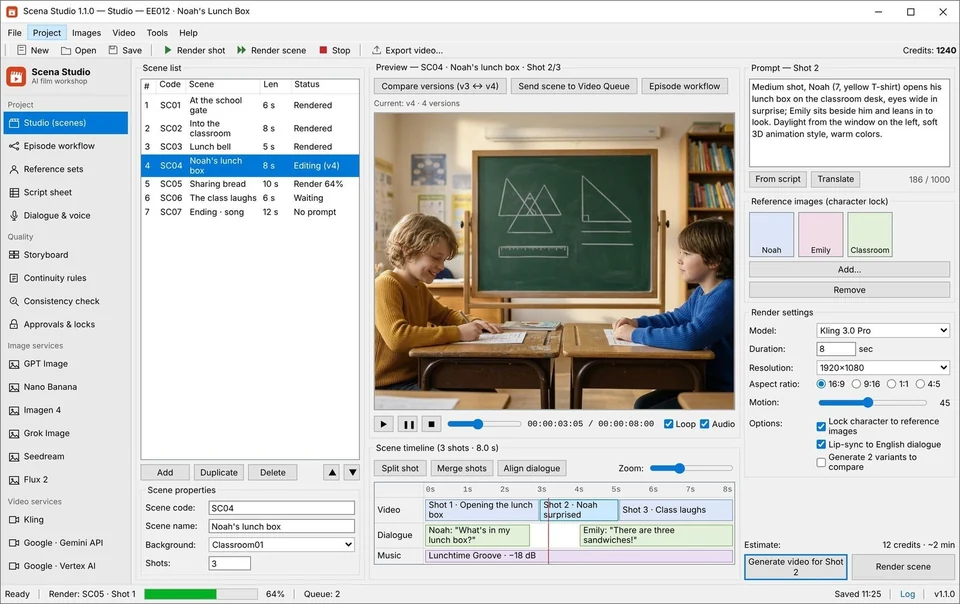
Scena Studio is a native Windows 10/11 desktop workstation for producing AI video series at channel volume: scripted in a sheet, queued across 39 AI services and 80+ models, locked to one cast, scored for facial drift on your own GPU, and exported in every aspect ratio the platforms pay for. The app is free during the Open Test. At the start, Scena Studio covers shared API use on enabled services.
It started as an internal studio tool—and every screen shows it.
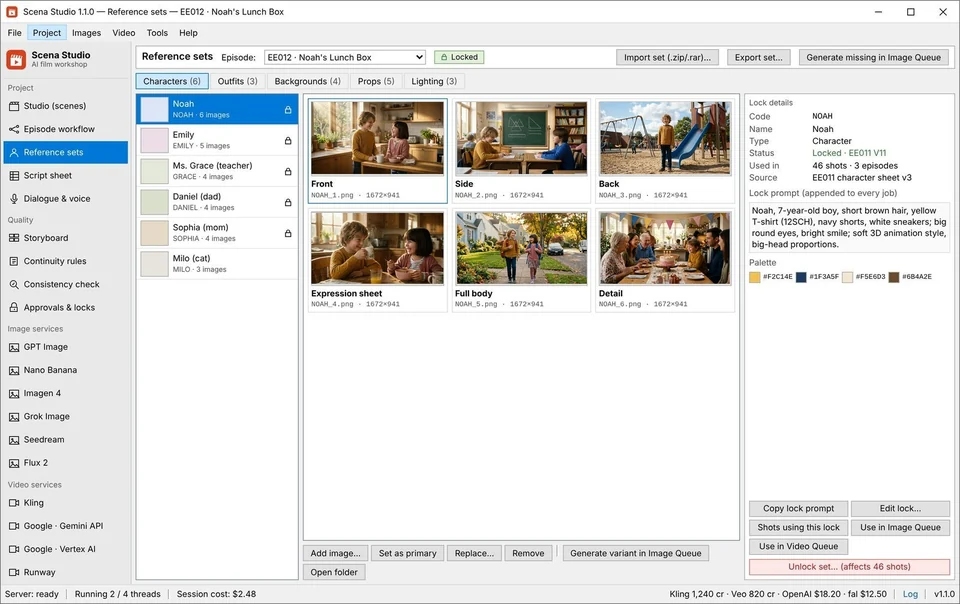
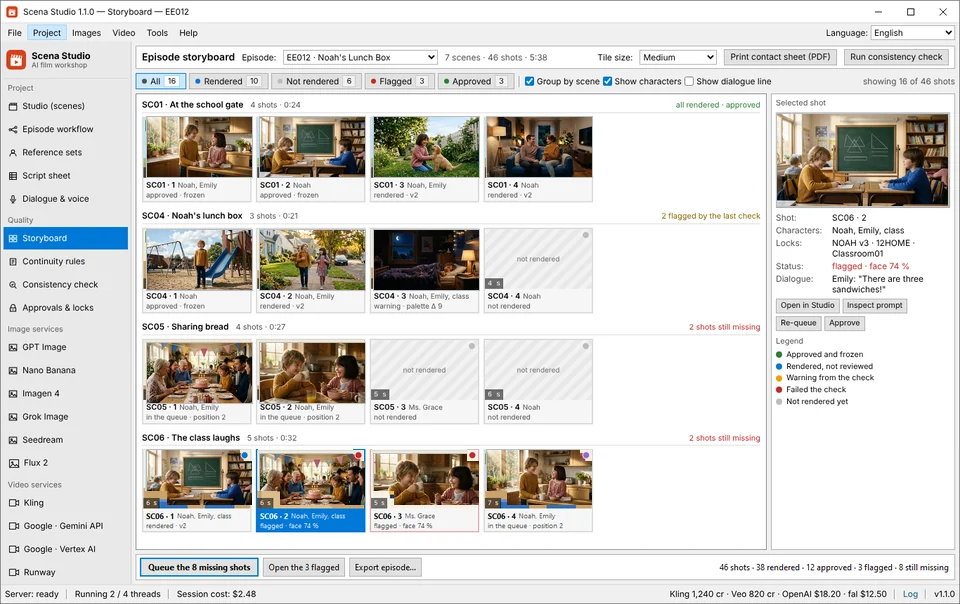
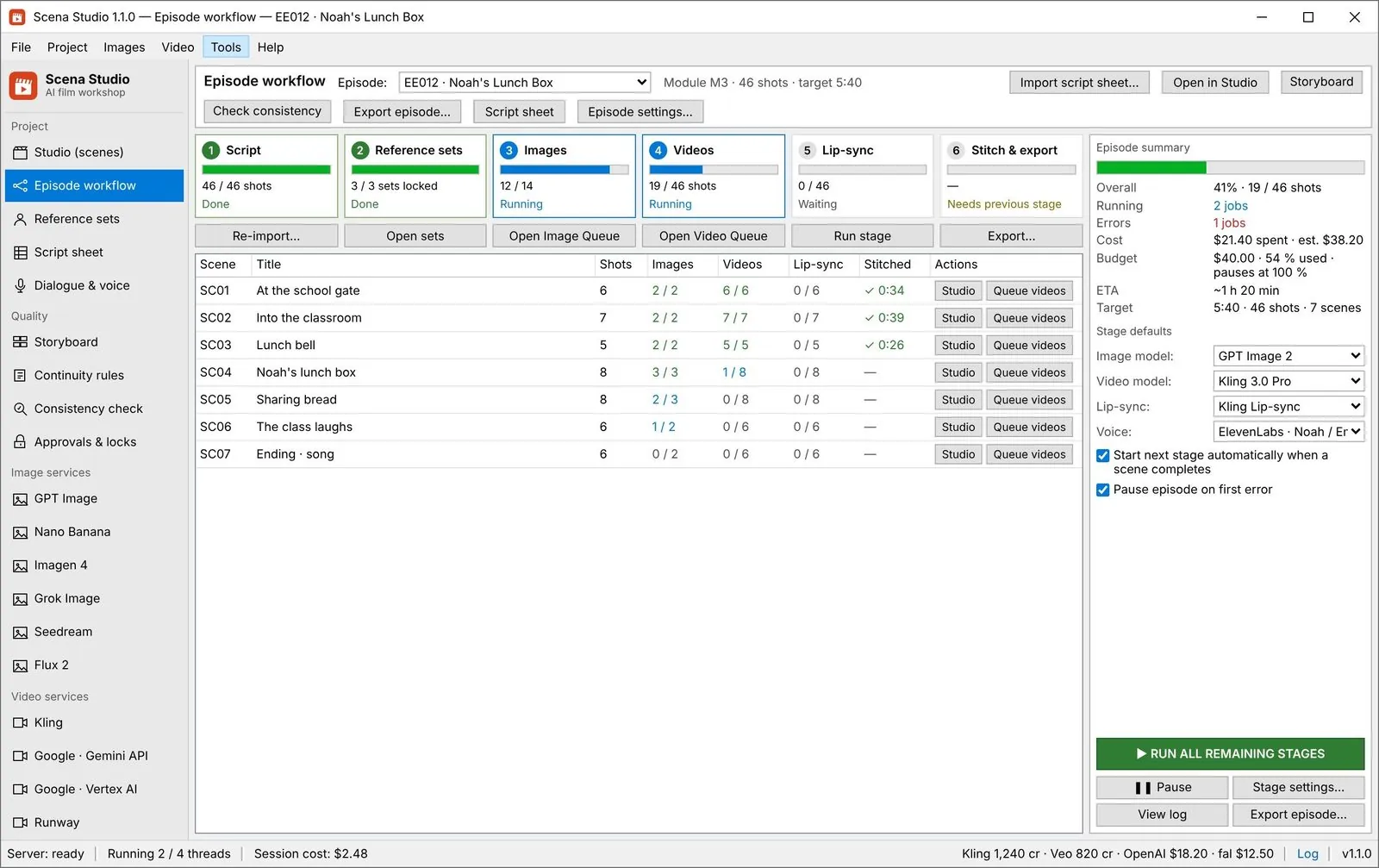
Scena Studio was born out of weekly episode production: forty-six shots per episode, the same four recurring characters and the same rooms, week after week. Every cloud AI video generator has a decent browser demo for a single five-second clip, and every single one of them forgets who your character was yesterday when you try to render Shot 14.
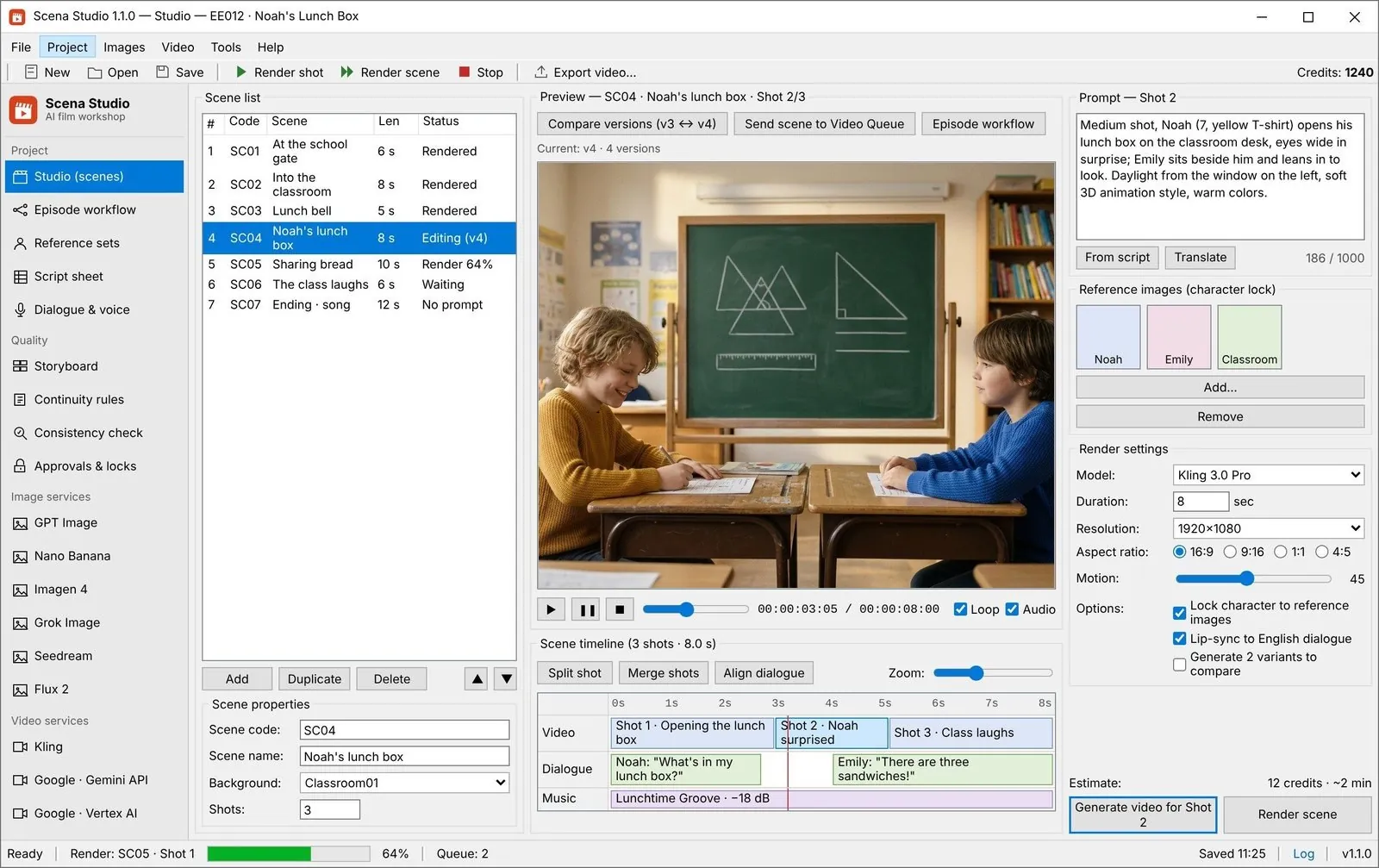
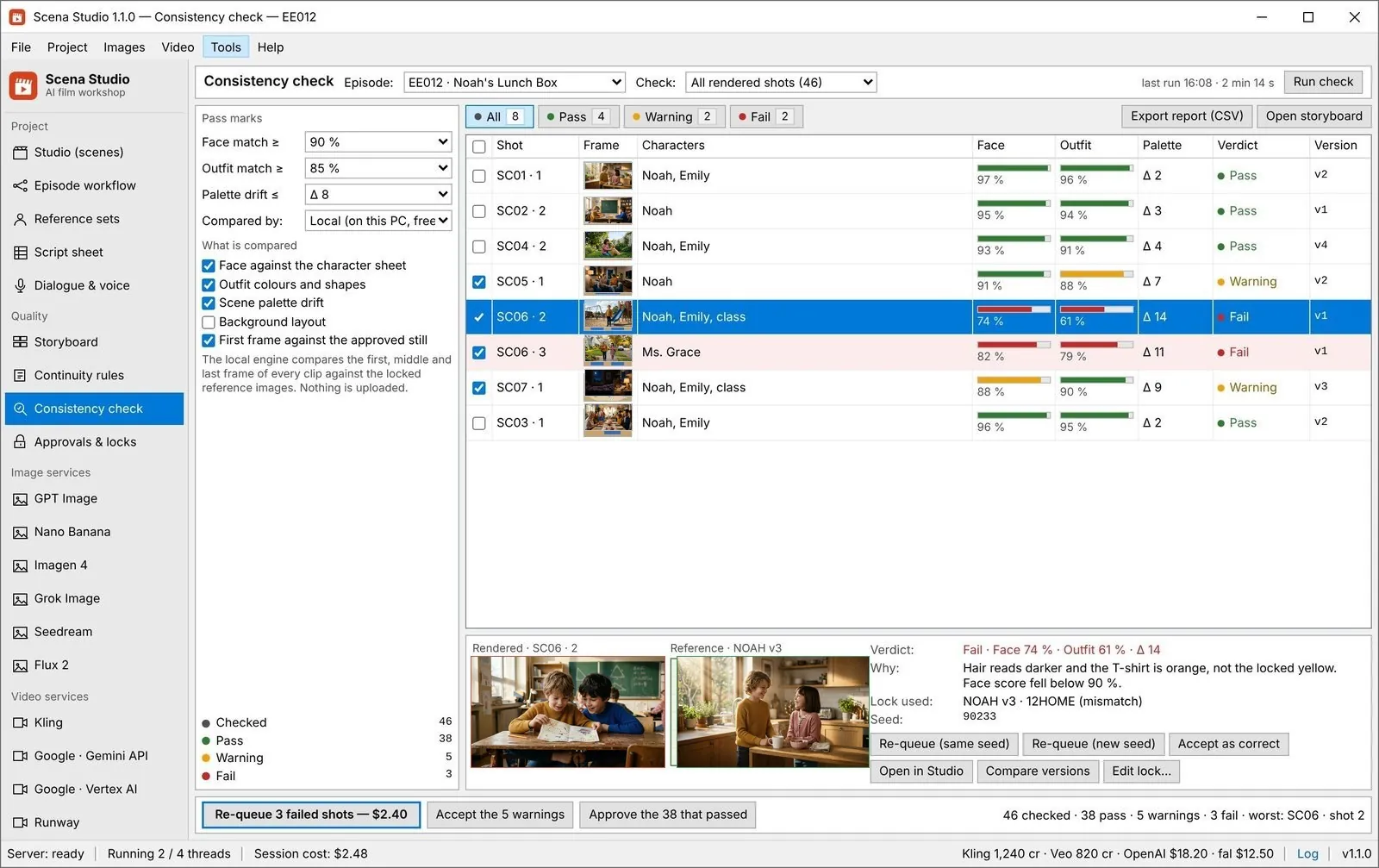
So the entire production line moved to a native Windows desktop workstation. An Excel or CSV script sheet goes in, a 4-thread batch queue routes each shot to the best model (Kling 4.0 for multi-character blocking, Veo 3.1 for emotional dialogue, Seedance 2.5 or Wan 3.0 for wide B-roll), reference locks keep the cast identical, an ArcFace ONNX check on your own GPU catches drift before you waste credits, and the finished episode exports at 16:9, 9:16, and 1:1 with −14 LUFS broadcast audio.
Why creators trust Scena Studio on their production PC
Installing a desktop executable and connecting paid API keys requires concrete technical guarantees—not marketing promises. Here is how you can verify every claim before running a single shot.
Hardware-bound API key encryption
When you enter a fal.ai, Google Vertex, OpenAI, or ElevenLabs key, it is encrypted locally using Windows CryptProtectData tied to your OS login. Keys never leave your PC except in direct HTTPS headers to the AI provider.
Public SHA-256 & binary audit
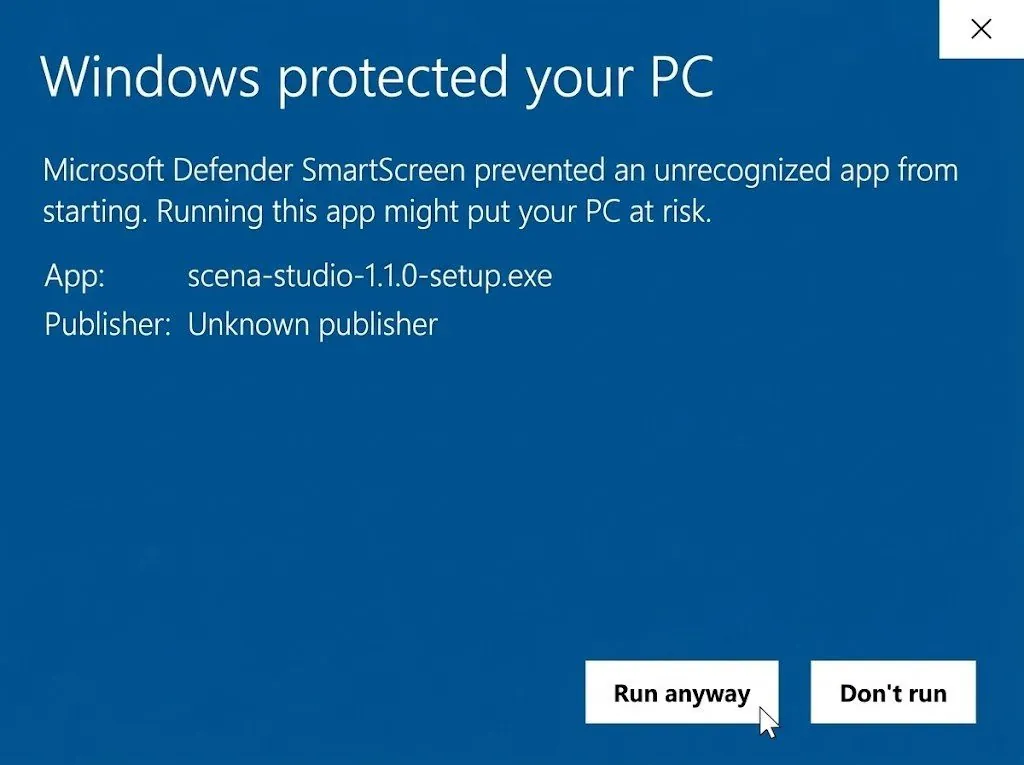
Every installer build (scena-studio-1.1.0.exe) is scanned across 72 antivirus engines with zero flags and published with its full SHA-256 checksum on our Trust Center so you can verify integrity via PowerShell.
Zero cloud lock-in or lost batches
Your script sheets, character reference plates, and .mp4 renders live in normal Windows folders on your drive. Crash-proof SQLite-WAL state saves every completed shot immediately to disk.
Real engineering support (< 24h)
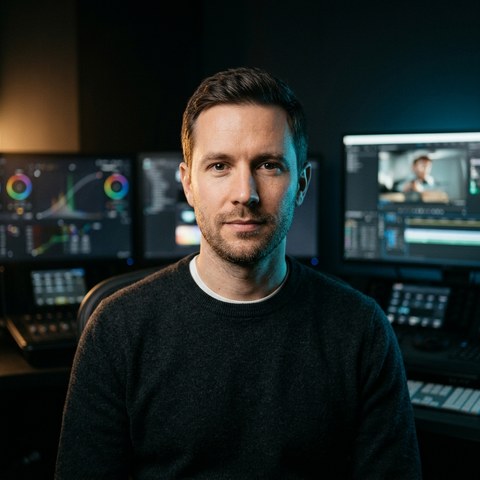
No chatbots or tier-1 scripts. Reports sent via Help → Report a problem attach sanitized local logs and go straight to founder Alex Mercer, with fixes documented in the public Changelog.
Where the project is in its life
Three phases. Only the first one has a date.
Open test
Finished enough to make a real episode, not finished enough to charge for. Everything is on, generation is free, and the job of this phase is to find what breaks in other people’s hands.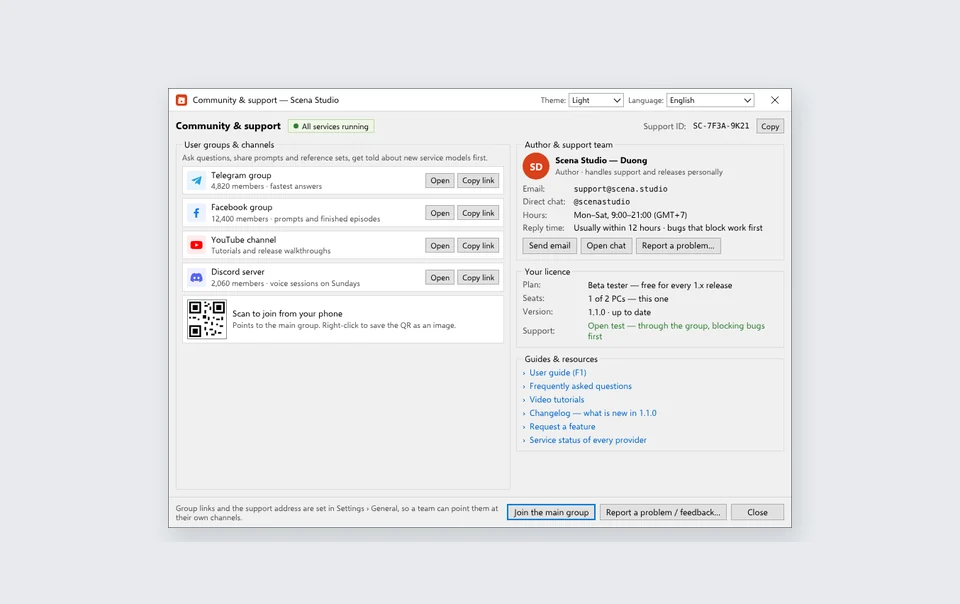
Optimisation
What the test turns up, worst first: cost per shot, queue speed, retries on a bad night, the services people ask for, and any screen that needs explaining twice.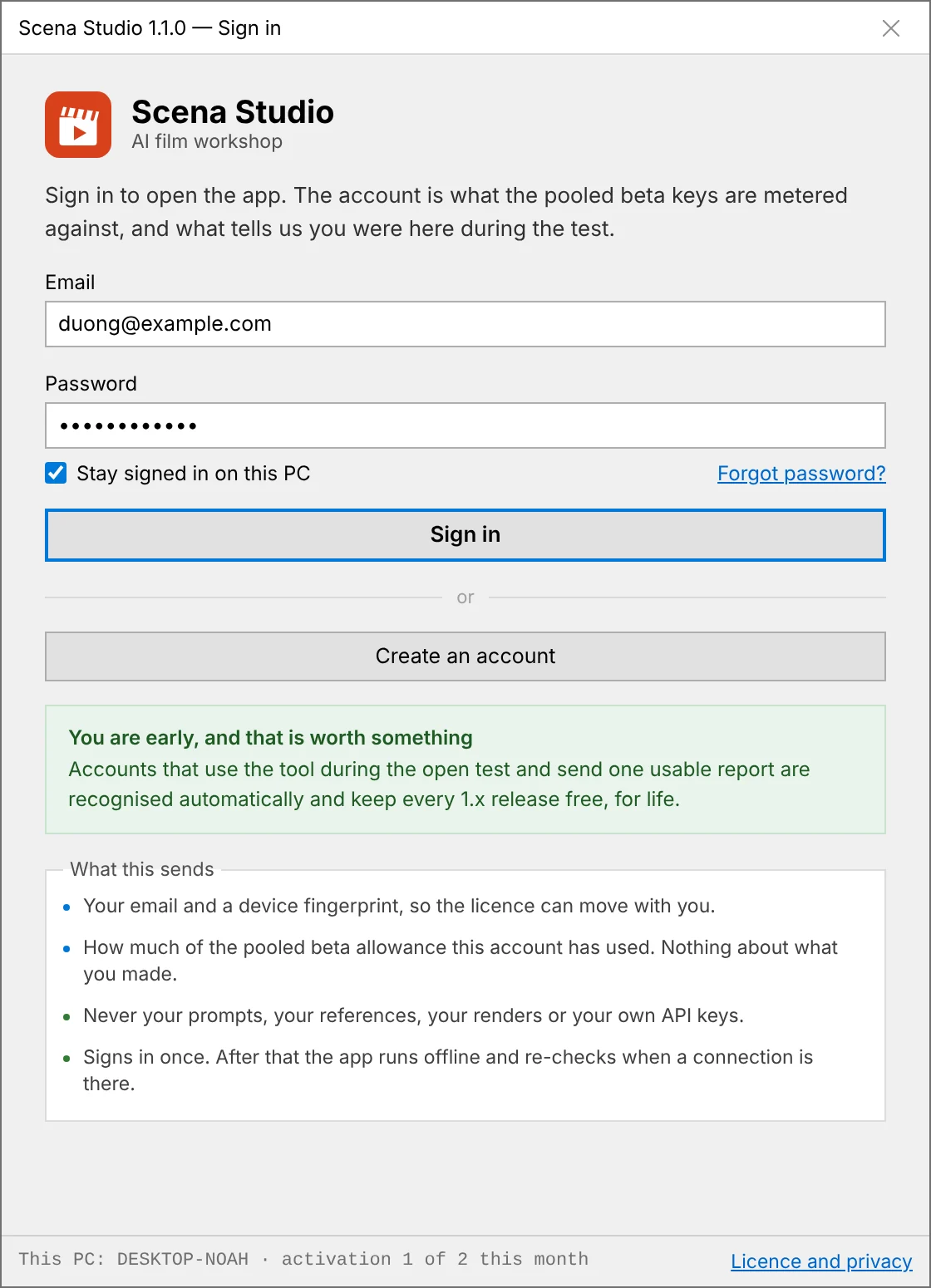
The signed build
Scena Studio becomes a licence: Free, Creator or Studio, by the month, the year or once. The proposed prices are on the pricing page now, and testers who earned a Studio key keep it.What the open test is, exactly
Scena Studio is free during Open Test. API access depends on the services available in your build.
Two honest caveats. Providers can limit request rates or make models temporarily unavailable. Once shared access ends, you must use your own API keys for AI generation. Your provider may charge for that usage. You keep the files you created.
Earning from this is a volume problem, and volume is what the app is for.
Every platform pays for something slightly different. The app makes one piece of work fit all of them without rendering it again.
YouTube
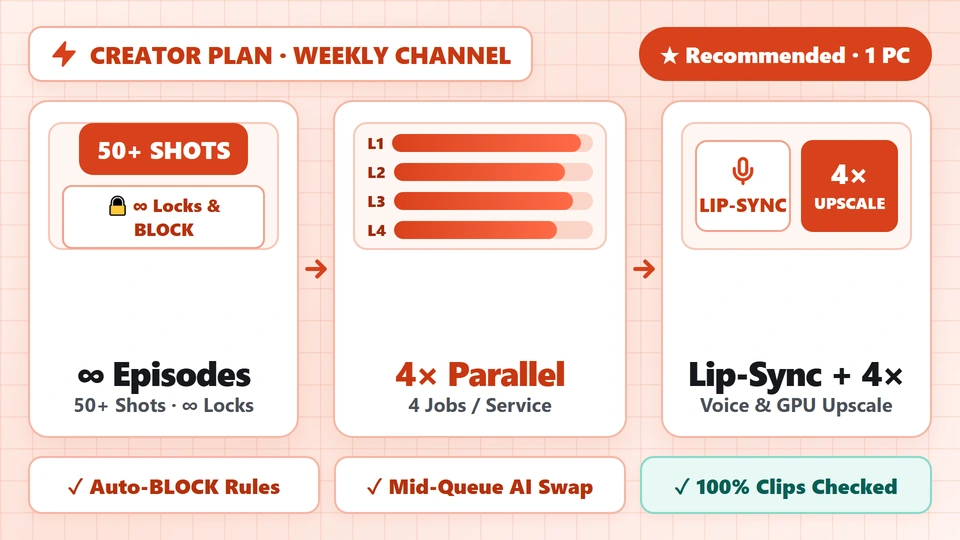
Long-form watch time on one side, a Shorts feed that always wants something new on the other. Getting paid takes a back catalogue and a schedule you can keep. One sheet, 40 to 60 shots, the same cast every episode, exported at 16:9 for the upload and 9:16 for the Shorts cut.
TikTok
Rewards frequency over polish. A miss costs almost nothing, so the winning move is more swings. Queue a week of verticals in one evening. Re-point a flat shot at another model without rewriting the prompt or losing the seed.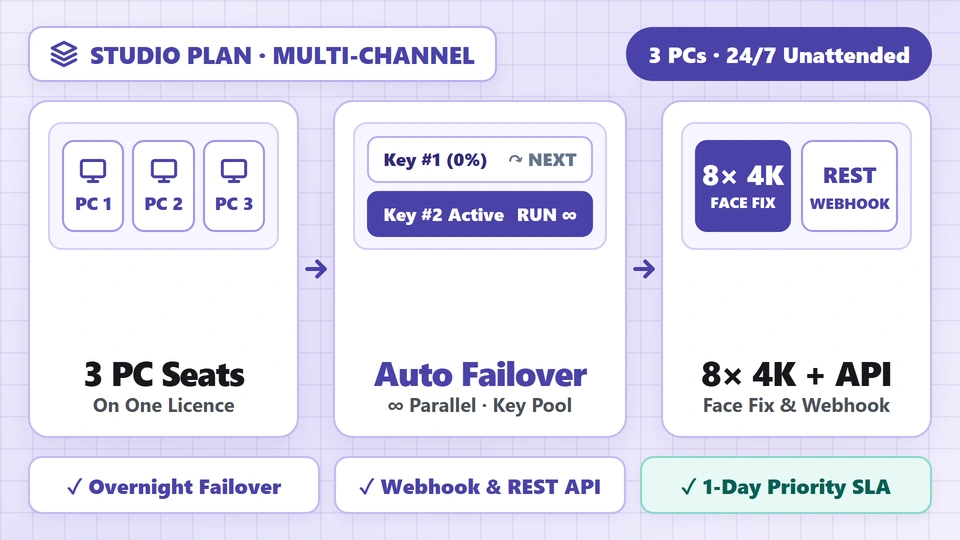
Meta: Reels and Facebook
The same cut goes to Reels, Facebook video and the feed, and each one wants its own shape. One shot comes out at 9:16, 1:1 and 16:9 together. You prompt it once and pay for it once.
Everywhere else, and client work
A second platform, a client’s channel, a site, an ad set: usually the same footage under someone else’s naming rules. Files land under your naming pattern, with the prompt, seed, service and cost recorded beside each render.What it cannot do. Make anyone watch. Volume buys more attempts and a faster loop between them, not an audience; a hundred bad videos are still a hundred bad videos. If an idea is wrong, this helps you find out ten times faster, and most weeks that is where the value is.
One channel is a hundred videos. Several channels is a filing problem.
Running several stories at once is what decides whether this is sustainable.